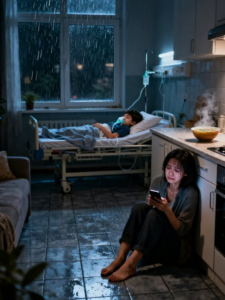
Meu nome é Lauren Cassidy, e eu nunca planejei ser mãe de ninguém.
Eu não tinha o temperamento nem a paciência necessários. Eu era a confiável — a irmã que pagava as contas em dia, chegava cedo ao trabalho e ficava até tarde para consertar a bagunça que os outros deixavam. Minha vida era organizada como às vezes acontece com espaços vazios — tranquila, previsível, intocada pelo caos familiar.
Até a noite em que Vanessa deixou o filho dela no meu sofá e desapareceu.
Estava chovendo tão forte que os postes de luz pareciam estar se afogando. Lembro-me porque a água batia na janela em rajadas irregulares, como se alguém tivesse mudado de ideia sobre entrar. Eu tinha acabado de dobrar a última leva de roupa — a minha, porque morava sozinha e não acumulava muita — e estava prestes a fazer um chá quando a campainha tocou.
arrow_forward_ios
Watch MorePause
00:00
00:1004:45Mute
Não é um toque educado.
Uma cutucada. Um pânico.
Abri a porta e lá estava ela, encharcada, com o rímel borrado e o cabelo grudado no rosto. Vanessa sempre parecia estar com pressa — como se a vida fosse um trem que ela sempre perdia, então corria atrás dele descalça e culpava a plataforma quando caía.
Ela não estava sozinha.
Um menino pequeno estava atrás dela, meio escondido pelo seu quadril. Dez anos, talvez. Magro de um jeito que crianças não deveriam ser magras. Seu moletom estava folgado como se pertencesse a alguém mais velho. Seu rosto estava pálido, os lábios quase acinzentados, e ele respirava como se cada inspiração e expiração fossem uma tarefa árdua.
“Lauren”, disse Vanessa, como se tivesse vindo em busca de açúcar. “Preciso que você fique de olho nele.”
Olhei para ela, depois para o menino. “Vanessa, já é meia-noite.”
“Eu sei.” Seus olhos se voltaram para a rua, para seu carro parado torto na calçada. “Só… só por um tempinho.”
O olhar do menino encontrou o meu, e o que vi ali foi pior que medo. Foi resignação. Daquelas que fazem você sentir como se estivesse olhando para alguém que já foi deixado para trás vezes demais.
“O que há de errado com ele?”, perguntei.
O maxilar de Vanessa se contraiu. “Nada.”
A mentira era tão óbvia que chegava a ser insultante.
O menino cambaleou levemente, e Vanessa o amparou com uma mão que parecia ter prática em fingir preocupação.
“O nome dele é Eli”, disse ela, rápido demais. “Ele está cansado.”
“Cansaço não tem essa aparência.”
A boca de Vanessa se contraiu, e por um segundo eu vi a irritação que ela sempre sentia quando alguém a obrigava a encarar as consequências.
“Não faça isso”, ela disparou. “Não esta noite. Eu não posso… Lauren, eu não posso.”
Eu me afastei automaticamente, porque, apesar de tudo, ela era minha irmã. E porque os joelhos do menino pareciam que iam ceder.
They came in and the smell came with them—wet fabric, stale cigarette smoke, something sour underneath like old sweat that had given up. Vanessa’s eyes flicked around my apartment, and I knew she was clocking the clean counters, the framed diploma on the wall, the little life I’d built by being careful.
She hated it. She always had.
Eli stood in my living room like he didn’t want to touch anything. Like he’d learned early that you don’t leave fingerprints in places you don’t belong.
“Sit,” I told him gently, nodding toward the couch.
He sat with slow caution, and when he leaned back, he winced. Not dramatic. Just a tiny flinch that made my stomach tighten.
Vanessa dropped a backpack at his feet. “There’s… stuff in there,” she said. “His meds.”
“Meds,” I repeated. “Vanessa.”
“It’s not a big deal.” She was already backing toward the door, eyes on the exit like my apartment was a burning building. “I just need a few days. A week, maybe.”
“A week?” My voice came out sharper than I meant. “You can’t just—Vanessa, where are you going?”
She hesitated, and something ugly flashed through her face: guilt, maybe, or anger that she had to be guilty.
“Somewhere,” she said. “To fix things.”
“With who?” I asked, because I already knew.
Her throat bobbed. “Randy and I—”
I let out a short, humorless laugh. “Oh my God. You’re leaving him for Randy.”
Vanessa’s eyes hardened. “Don’t act like you know anything.”
“I know you,” I said. “And I know you don’t ‘fix things.’ You run until you get tired, then you dump the mess on someone else.”
Eli’s head tilted slightly, like he was listening even though he looked like he wanted to disappear into the couch.
Vanessa lowered her voice, like the walls might judge her. “He needs stability. You have that.”
“You mean I have a couch,” I said.
She took a step closer, eyes blazing now. “You think you’re better than me because you have a 401(k) and matching towels?”
“I think I’m better than you because I’m not leaving a sick kid on someone’s furniture and vanishing,” I said, and my own voice shook because I could hear how real it sounded.
Vanessa’s lips parted, and for a second I thought she might slap me. She’d hit people before—boyfriends, bartenders, our own mother once, when she was drunk and furious. Violence was Vanessa’s punctuation mark.
Instead she leaned in, close enough that I could smell the alcohol on her breath.
“Don’t call anyone,” she whispered. “Don’t call Mom. Don’t call the hospital. Just… keep him quiet. Please.”
“Keep him quiet?” I stared at her. “What does that even mean?”
But she was already moving again, already grabbing her keys, already halfway out my door like my questions were a fire alarm she could ignore.
“Vanessa!” I grabbed her arm.
She yanked away so hard my fingers slipped off her wet sleeve. Her eyes met mine one last time—wild, pleading, and strangely cold.
“He’s yours for now,” she said.
Then she left.
The door clicked shut behind her, and in the sudden quiet, I could hear the rain again, relentless and loud. I stood there for a second with my hand still outstretched, like my body hadn’t accepted that she was gone.
Eli cleared his throat—soft, painful.
“Is she coming back?” he asked.
His voice was small. Not childish. Just… careful.
I looked at him on my couch, too pale, too thin, holding himself like a person trying not to take up space.
And I said the first honest thing I’d said all night.
“I don’t know,” I told him.
I went for the backpack as gently as I could. “Let me see your meds.”
He didn’t fight me, which scared me. Kids fight. Sick kids especially. They cry, they get mad, they cling. Eli just watched me with those tired eyes, like he’d learned that resistance didn’t change anything.
Inside the backpack was a plastic bag of pill bottles with his name on them. Not Cassidy. Not even his full name. Just “Eli C.” like the rest of his identity had been smudged out.
There was also a hospital discharge paper folded into quarters, stained at the edges. I opened it and felt my stomach drop.
Diagnosis: Acute lymphoblastic leukemia.
Follow-up: Immediate.
Medication schedule written in careful nurse handwriting.
I looked at the date.
Three days ago.
My mouth went dry. “Eli,” I said, keeping my voice steady by force, “when was the last time you went to the hospital?”
He shrugged, slow. “Last week.”
“Are you supposed to be… back?”
He picked at a loose thread on his sleeve. “Mom said we were leaving. She said doctors ask too many questions.”
I stared at him, and something hot rose in my chest. Rage, sharp and clean.
Vanessa hadn’t dropped off a “tired” kid.
She’d dropped off a kid in the middle of cancer treatment.
And she’d told me not to call anyone.
I saw it then, plain as day: she wasn’t just running away with her lover.
She was running away from responsibility, from bills, from social workers, from the terrible, unglamorous reality of having a child who was sick.
I crouched in front of Eli. “How do you feel?” I asked.
He hesitated, like he didn’t want to complain. “Kinda… dizzy.”
“Any fever?”
He shrugged again. “Sometimes.”
His skin felt warm when I touched his forehead. Too warm.
My decision made itself.
“I’m taking you to the ER,” I said.
His eyes widened. “Mom said—”
“I’m not your mom,” I said, and then immediately regretted how harsh it sounded, because his face tightened like I’d confirmed something he’d been afraid of.
I softened my voice. “But I’m not letting you get worse. Okay?”
Eli stared at me a long moment, then gave a tiny nod.
In the car, he held his backpack against his chest like a life vest. I drove with one hand on the wheel, the other gripping my phone so hard my fingers ached. I called Vanessa ten times. Straight to voicemail.
I called my mother. I didn’t want to. My mother and I had a relationship made of careful distance and holidays performed like obligations. But this was bigger than pride.
She answered on the third ring, breathy like she’d been asleep.
“Lauren? Is someone dead?”
“Vanessa,” I said. “She left Eli with me. He has leukemia.”
Silence.
Then my mother exhaled through her nose like she was annoyed at the inconvenience of it.
“She said he’s fine,” my mother said.
“He is not fine,” I snapped, and then felt that strange childish sting of being scolded without words. “He needs treatment. I’m taking him to the hospital.”
My mother’s voice sharpened. “Where is Vanessa?”
“Gone.”
“Well, don’t drag us into her drama,” my mother said, like a script she’d been reading my whole life. “You always do this. You always make it your problem.”
I gripped the wheel until my knuckles burned. “It is my problem because he’s in my car,” I said. “Because he’s a child.”
A pause, then, colder: “Call social services.”
“I am,” I said, and hung up before she could say anything else that would make me hate her more.
The ER was bright and loud and indifferent, like pain was background noise. Nurses moved fast. Eli’s temperature was high enough to make one of them swear under her breath. They got him into a room, took blood, hooked him to monitors.
A social worker arrived after an hour, her expression practiced sympathy.
“Lauren Cassidy?” she asked.
I nodded, my mouth still tasting like fear.
“Are you his guardian?”
“No,” I said. “His mother left him at my apartment.”
“Do you have her contact information?”
I laughed once, bitter. “If you find it, let me know.”
They tried. The hospital tried. Social services tried. The police tried.
Vanessa had vanished like she’d never existed, except she had—her name was on Eli’s birth certificate, her signature on old school forms, her fingerprints all over the wreckage.
And now she was gone, and her ten-year-old son was in a hospital bed with tubes in his arms and a backpack clutched to his chest like he was still afraid someone would take even that.
The first night, after they stabilized him, Eli asked me in a small voice, “Are they gonna send me away?”
“No,” I said automatically, then realized I didn’t actually know.
The social worker had been careful, but clear. Without a legal guardian present, there were steps. Foster placement. Emergency custody. Court hearings.
Eli heard every word even when they tried to whisper it in the hallway.
He started to shake around midnight, teeth chattering, eyes wide.
“It’s okay,” I told him, sitting in the chair beside his bed. “It’s okay.”
He swallowed hard. “I don’t wanna go back to Randy’s house.”
My head snapped up. “Randy?”
Eli’s gaze dropped. “Mom’s boyfriend.”
“Did he… hurt you?” I asked, careful.
Eli hesitated. Then, with the matter-of-factness of a kid describing weather, he said, “He gets mad. He throws stuff. Sometimes Mom hides in the bathroom and tells me to be quiet so he doesn’t remember I’m there.”
My throat tightened so hard it hurt.
I reached out and took his hand. It was too thin, bones sharp under skin.
“You’re safe,” I said, and this time, I meant it as a promise I would make true.
The next morning, I told the social worker I would take temporary custody.
She looked at me like she’d seen people say brave things and crumble under paperwork.
“It’s a process,” she warned.
“I know,” I said. “Start it.”
I called in sick to work. Then I called again the next day. Then again. My boss, a kind woman named Denise who’d always teased me for being too responsible, finally said, “Lauren, are you okay?”
“No,” I said, because there was no point lying.
“Do what you have to do,” Denise told me. “We’ll figure it out.”
I didn’t know then how many times that sentence would save me.
Weeks turned into months. Vanessa didn’t resurface. Randy didn’t either, thank God, though I lived in constant dread of his shadow at my door. Eli’s treatment restarted with brutal urgency. Chemo was a thief—it stole his energy, his appetite, his hair.
The first time clumps of it came out in the shower at my apartment, Eli stood there staring at the drain like it was swallowing him.
“I look weird,” he said.
“You look like a badass,” I replied, forcing brightness into my voice even as my heart broke.
He blinked at me. “What’s a badass?”
“It’s someone who keeps going even when everything sucks,” I said.
He considered that, then nodded slowly like he was filing it away as a job description.
I learned how to cook bland food that wouldn’t make him nauseous. I learned how to read lab results without crying. I learned how to argue with insurance companies with a voice so calm it scared even me. I learned how to hold a child when he vomited at 3 a.m., then get up at 6 and go to work with concealer under my eyes.
My neat life became a battlefield of pill schedules and doctor appointments, and somehow, in the middle of it, it also became… full.
Eli had a dry humor that appeared when you least expected it. When he lost his eyebrows, he stared at his face in the mirror and said, “I look surprised forever.”
When I told him he had to eat at least three bites of mashed potatoes, he sighed dramatically and said, “This is oppression.”
When I tried to read him a book and stumbled over a word, he corrected me with a grin and said, “You’re supposed to be the grown-up.”
“I’m faking it,” I admitted.
He leaned back against my shoulder. “Me too.”
There were court hearings. Background checks. Home visits. A judge with kind eyes asked me if I understood what I was taking on.
I wanted to say no. I wanted to say I was exhausted, scared, furious, unprepared.
Instead I said, “Yes.”
Because what else could I say? That I’d leave him to the system? That I’d hand him back to the mother who’d abandoned him?
I became his legal guardian.
I told myself it was temporary.
Then a year passed.
Then two.
Eli went into remission.
The day the doctor said the word, the room seemed to tilt. Remission. Like a doorway opening after you’ve been trapped in a burning house.
Eli sat up straighter, his eyes bright. “Does that mean I’m done?”
“It means we breathe,” the doctor said gently. “And we keep watching.”
We went to a diner after, because I didn’t know how else to celebrate. Eli ate pancakes like they were a victory. Syrup dripped down his chin and he didn’t care. He laughed—a full, loud laugh that turned heads—and I realized I hadn’t heard that sound in so long I’d forgotten what it did to my chest.
It made something inside me soften.
It made me love him.
Not like a duty.
Not like a project.
Like a mother.
I didn’t say it out loud, because saying it felt like tempting fate. Like if I named it, the universe would reach in and snatch it away.
Vanessa stayed gone. Once, a postcard arrived with no return address. A beach at sunset, palm trees, the kind of picture people send when they want you to envy them.
On the back, in Vanessa’s slanted handwriting: Tell him I’ll be back soon.
That was it.
No apology.
No question about his treatment.
No “How is my child?”
Just a promise as flimsy as the paper it was written on.
Eli found it in the mail pile and stared at it for a long time.
“She’s alive,” he said finally.
“Yes,” I said carefully.
He flipped it over, looked at the beach again, then tossed it into the trash like it was junk mail. “Cool,” he said, voice flat.
That night I heard him crying quietly in his room, and I stood outside his door with my hand on the knob, frozen between respecting his privacy and wanting to scoop him up like he was still small.
I knocked softly instead. “Eli?”
Silence.
Then: “Go away.”
So I went to the kitchen and sat on the floor, back against the cabinets, and cried silently into my own hands, because sometimes being the dependable one means you carry pain in places no one sees.
Two years after remission, Randy showed up.
It was a Tuesday. I remember because Tuesdays were grocery day. I had just brought in bags and was putting milk in the fridge when the knocking started.
Not a ring.
A pounding. Angry and impatient.
My stomach clenched as I walked to the door.
I opened it and there he was—Randy Mercer, taller than I remembered from the one time I’d seen him at a family barbecue, face weathered, eyes bloodshot. He smelled like cigarettes and cheap cologne and something rotten underneath—resentment, maybe.
“Where’s Vanessa?” he demanded.
I blinked. “Excuse me?”
He shoved a hand against my doorframe, leaning in like he owned the space. “Don’t play dumb. She took my car and disappeared. I’m looking for her.”
“I haven’t seen her in years,” I said.
Randy’s eyes flicked past me into my apartment, and I felt my skin go cold. “Is the kid here?”
My whole body went rigid. “No,” I lied.
Then Eli’s voice drifted from the hallway. “Lauren? Who is it?”
Randy’s mouth curved into a nasty smile. “There he is.”
I moved to block the doorway. “Get off my property.”
Randy laughed, a harsh bark. “Property,” he mocked. “Look at you. Queen of the suburbs. Listen, sweetheart, Vanessa left me holding the bag. I’m not leaving empty-handed.”
“I don’t know what you want,” I said, keeping my voice steady through sheer will.
Randy’s eyes narrowed. “I want what she owes.”
“She owes you?” I repeated, incredulous.
“Don’t get cute.” His gaze shifted again, toward Eli’s voice. “Maybe I’ll take the kid. Sell his sob story. People love sick kids. Make a few bucks.”
Something snapped inside me. It wasn’t courage, exactly. It was fury. Protective, bright, unstoppable.
“You take one step into my house,” I said, “and I will call the police so fast your head will spin.”
Randy leaned closer, breath sour. “You really think they’ll take your side? You’re not his mom. You’re just the aunt who plays house.”
Eli appeared behind me then, smaller than Randy but standing tall anyway, his eyes sharp.
“Get away from her,” Eli said.
Randy’s gaze slid to him. “Look at you,” he sneered. “Still alive. Guess Vanessa didn’t kill you after all.”
Eli flinched, just barely, but he didn’t back up.
I stepped forward, rage and fear tangled. “Leave. Now.”
Randy’s hand shot out, grabbing my wrist. Not hard enough to bruise yet. Hard enough to threaten.
“I said—”
I didn’t think. I reacted.
I drove my knee up into his shin and yanked my arm free. Randy cursed, stumbling back. He swung his hand, and for a second I thought he was going to hit me.
Eli grabbed a ceramic bowl from the counter behind us—one of my nice ones—and raised it like a weapon with shaking hands.
“Touch her,” Eli said, voice trembling, “and I’ll break this on your head.”
Randy stared at him, then laughed again, but there was uncertainty in it now.
“You’re crazy,” Randy spat, backing away. “All of you.”
I slammed the door and locked it, my hands shaking so badly I fumbled the latch.
When I turned, Eli was still holding the bowl, his face tight.
“You okay?” I asked softly.
He swallowed hard and set the bowl down carefully like it might explode. “Yeah,” he said, but his voice cracked. “Is he gonna come back?”
“No,” I said, and then added the truth I’d been avoiding for years. “And even if he does, he doesn’t get you. Nobody gets you.”
Eli’s eyes shone. He looked away fast, embarrassed by emotion, and muttered, “Good. Because you’re stuck with me.”
I laughed through the ache in my chest. “I know,” I said. “Terrible luck.”
We called the police anyway. Filed a report. Changed the locks. I slept with my phone under my pillow for months.
Vanessa stayed gone.
Time kept moving, because time doesn’t care about what you survive.
Eli grew into his teenage body like a plant reaching for light. He got taller. Stronger. His hair came back in soft, dark curls. He learned to drive in my old Honda, blasting music and acting annoyed when I told him to use his blinker.
He made friends. He joined the debate team. He flirted awkwardly with a girl named Samira who wore oversized hoodies and had a laugh that filled the hallway.
Sometimes, in quiet moments, I’d catch him staring at mothers with their kids—at the grocery store, at school events—and his face would go distant.
One night, when he was thirteen, he asked, “Do you think she ever thinks about me?”
I was washing dishes. My hands froze in the sudsy water.
“Who?” I asked, though I knew.
“My mom,” he said, voice flat like he didn’t care, like it was just curiosity.
I dried my hands slowly. “I don’t know,” I admitted.
Eli nodded like he’d expected that answer. “Okay.”
He turned to go to his room, then paused and added, quieter, “Sometimes I hate her so much I feel sick.”
My throat tightened. “That’s normal,” I said.
He looked at me then, eyes tired in a way no kid’s eyes should be. “Sometimes I miss her too,” he whispered, like it was a confession.
I crossed the kitchen and pulled him into my arms. He stiffened for a second—teenage pride—then melted into me with a shaky breath.
“You can feel both,” I murmured into his hair. “It doesn’t make you weak.”
He swallowed hard. “Does it make me stupid?”
“No,” I said fiercely. “It makes you human.”
A month later, his bloodwork changed.
We caught it early, because I had become the kind of person who read lab reports like prayer. The doctor’s face was gentle when he said the word relapse, but it still landed like a punch.
Eli stared at the floor. “So… we do it again.”
“Yes,” I said, my voice steady even as my insides crumbled. “And we win again.”
He nodded once. “Okay.”
Chemo round two was harder. Eli was older, more aware, and the awareness made everything sharper. He got angry. He snapped at me over nothing. He threw a cup once, hard enough to shatter against the wall.
Then he slid down to the floor and sobbed like he was five again.
“I’m sorry,” he choked out. “I’m sorry, I’m sorry—”
“Stop apologizing,” I said, kneeling beside him. I gathered him in my arms as glass glittered on the floor like broken ice. “You’re allowed to be mad.”
“I don’t want to die,” he whispered.
My heart cracked cleanly. “You’re not going to,” I lied, because love makes liars out of us.
Eli spent more time in the hospital than at home. I brought him books, games, his favorite hoodie. Samira visited and pretended she wasn’t scared, sitting on the edge of his bed and telling him gossip about school like it was normal.
One afternoon, while he slept, I found him writing something in a notebook. He snapped it shut when he noticed me.
“What’s that?” I asked gently.
“Nothing,” he said too fast.
I sat in the chair beside him, watching his fingers twist the edge of the blanket. “Eli,” I said softly, “if there’s something you need to say—”
He swallowed. His eyes glistened. “I’m writing letters,” he admitted.
“To who?”
He stared at the wall. “To her.”
My breath caught. “Vanessa.”
He nodded, jaw tight. “I don’t know why. I don’t even know where she is. I just… I have stuff in my head and it feels like poison.”
I reached out and touched his hand. “Do you want me to help you find her?”
Eli’s eyes flashed with panic. “No.”
The answer was immediate, like a reflex.
I nodded slowly. “Okay.”
He exhaled shakily. “If she ever comes back,” he said, voice rough, “promise you’ll tell her… the truth.”
I blinked. “What truth?”
Eli’s gaze met mine. It was steady, older than thirteen.
“That I waited,” he said. “That I stopped waiting. That you were the one who stayed.”
My throat tightened so much I couldn’t speak. I just nodded, because it was the only thing my body could do without falling apart.
Eli got worse in the winter.
The doctor started using careful phrases. “We’re running out of options.” “We can try a different protocol.” “We should talk about comfort.”
I sat in the hallway outside his room and stared at the beige walls until my eyes burned. I wanted to scream. I wanted to hunt Vanessa down by sheer will and drag her into that hospital so she would have to see what she’d done.
But Vanessa was a ghost, and ghosts don’t come when you call.
Eli asked to go home.
Not for a weekend.
For good.
Hospice came into my living room like a quiet surrender—nurses with kind voices, equipment that smelled like plastic, pamphlets that pretended death was a manageable process.
Eli’s bed was moved to the spot near the window where the rain had once hammered and changed everything.
He was fourteen then. A kid with old eyes and a body that had fought too many wars.
One night, he asked me to sit beside him. The room was dim, only the lamp on, casting soft light over his face. His hair had thinned again, but he still had those stubborn curls.
“Lauren?” he said.
“Yeah,” I whispered.
He swallowed, his throat moving with effort. “Do you… do you ever wish you’d said no?”
My heart lurched. “No,” I said immediately.
He blinked slowly, like he was tired of holding himself together. “You don’t have to lie,” he murmured.
So I told him the truth the way you tell truth to someone you love—carefully, like setting down something fragile.
“I wish you hadn’t gotten sick,” I said. “I wish Vanessa hadn’t been Vanessa. I wish I didn’t have to watch you hurt. But I don’t wish you away. Ever.”
Eli’s lips quivered into something like a smile. “Good,” he whispered. “Because you’re… you’re my person.”
Tears slid down my face silently. “You’re mine too,” I said.
He stared up at the ceiling for a moment, then whispered, “Do you think… there’s something after?”
“I don’t know,” I admitted.
Eli nodded, calm. “I hope there’s a couch,” he said faintly. “But like… a good one. Not the scratchy kind.”
A laugh broke out of me, wet and shaking. “We’ll put in a request,” I said.
Eli’s eyes drifted toward the window. The rain had stopped; the glass showed only darkness and faint streetlight glow.
“I’m not scared,” he whispered.
I held his hand tighter. “Okay.”
He breathed in, slow, and said, so softly I almost didn’t hear it, “Tell her… I forgave her. But… tell her I’m mad too.”
“I will,” I promised, and this time I meant it.
He died in the early morning, quiet as snowfall. No dramatic last words. Just a long exhale and then stillness, like his body finally stopped fighting.
I sat there for a long time with his hand in mine, my forehead pressed to the blanket, making no sound because I couldn’t imagine noise belonging in a world that had just lost him.
After, there was the practical horror—calls to make, forms to sign, people to inform. My mother showed up at the funeral wearing black like a costume and said, “Well, you did what you could,” as if I’d lost a pet.
I didn’t speak to her for a year.
I kept Eli’s letters in a shoebox in my closet. Dozens of them, sealed, addressed to Vanessa with no address. Anger and love trapped in paper.
I moved apartments eventually. Bought a small house in a quieter neighborhood. Painted the living room a warm color because I no longer cared about being “neat.”
I went on with my life because there’s no other choice. I worked. I paid bills. I sometimes smiled at strangers and wondered if they could see the emptiness behind my eyes.
And then, seventeen years after the night Vanessa left, my doorbell rang.
It was daytime. Bright. Ordinary.
The kind of ordinary that makes you think nothing terrible can happen.
I opened the door and saw her, and for a second my brain refused to connect the woman in front of me with the sister in my memories.
Vanessa looked… worn.
Older, obviously, but not in the normal way. Her skin had a grayish tint, like life had drained out of it. Her hair was thinner, dyed a brittle blonde that didn’t hide the dark roots. She wore a cheap coat and her hands shook slightly when she lifted them.
“Lauren,” she said.
My stomach turned over.
I didn’t step aside this time. I didn’t invite her in. I just stood in the doorway like a locked gate.
“You’re alive,” I said, and my voice didn’t sound like mine. It sounded like someone who’d been holding a scream for years.
Vanessa licked her lips. “Yeah.”
“Why are you here?”
Her eyes flicked over my house—my porch, my clean windows, the life I’d rebuilt on ashes. “I need to talk,” she said.
“About what?” I asked, though my pulse already knew.
Vanessa’s throat bobbed. She swallowed hard like she was trying to force courage down.
“About Eli,” she said.
My whole body went still, like someone had pulled a switch.
“You don’t get to say his name,” I said quietly.
Vanessa flinched, then tried to straighten. “He’s my son.”
“No,” I said, and the word came out cold. “He was your son. For ten years. Then you left him on my couch and disappeared.”
Vanessa’s eyes darted away. “I didn’t disappear. I—things happened.”
“Things always happen to you,” I said. “Nothing is ever your fault.”
Her jaw tightened, and for a second I saw the old Vanessa—the one who turned any accusation into a fight.
“I’m not here to argue,” she snapped. Then her voice softened, shaky. “I just… I need to know where he is.”
The question hit me like a slap, because it carried an assumption so cruel it almost made me laugh.
Where he is.
Like he’d be grown now. Like he’d be alive.
Like she could just pick up where she left off.
My hands curled into fists at my sides.
Vanessa stepped forward, eyes pleading now. “I’ve been looking,” she said, voice cracking. “I didn’t know how to—Lauren, I didn’t have money, I didn’t have—Randy—”
“Don’t say his name like he’s an excuse,” I hissed.
Her eyes shimmered with tears. “I didn’t mean to leave him forever.”
“But you did,” I said. “You left him when he was sick.”
Vanessa’s face twisted. “He wasn’t that sick,” she snapped automatically—and then immediately looked horrified, because the lie had slipped out like muscle memory.
I stared at her. “He had cancer,” I said, each word a stone. “He was in treatment. He needed his mother.”
Vanessa’s lips trembled. “Stop,” she whispered.
“I sat with him while he threw up into a bucket,” I said, voice rising. “I held him when his hair fell out in my shower. I signed forms you should’ve signed. I begged doctors for more time. I watched him stare at the mailbox like it might bring him back the person who left him.”
Vanessa’s face crumpled. “I didn’t know,” she sobbed.
“Yes, you did,” I said. “You just didn’t want to.”
Her knees looked unsteady. She grabbed the porch railing like the world was tilting.
“Where is he?” she asked again, voice smaller. “Please. I just need to see him.”
I could have shut the door. I could have ended it right there.
But Eli had asked me for the truth.
And the truth was the only thing I had left that belonged to him.
So I stared at my sister—the woman who had set my life on fire and walked away whistling—and I gave her the answer she had earned.
“He died,” I said.
The words fell into the air like something breaking.
Vanessa blinked hard, like she’d misheard. “No,” she whispered. “No, that’s not—he’d be… he’d be twenty-seven.”
“He never got to be twenty-seven,” I said, and my voice was terrifyingly calm now. “He died when he was fourteen.”
Vanessa’s face went slack. Her mouth opened, but nothing came out.
I kept going, because the truth doesn’t stop once you open it.
“He asked about you,” I said. “Even when he hated you. Even when he pretended he didn’t care. He wrote you letters. He kept writing even when he didn’t know where to send them.”
Vanessa’s eyes rolled back slightly. Her hand slid off the railing.
“Lauren…” she gasped, like my name could save her.
“It was winter,” I said, because details matter when you’re finally heard. “He wanted to go home. He wanted to be on that couch you left him on. He said he hoped heaven had a better couch.”
Vanessa made a sound like an animal, raw and broken.
Then her legs gave out.
She collapsed on my porch, not gracefully, not dramatically—just crumpling like her bones had finally admitted what her mind couldn’t hold.
For one second, I felt nothing.
Then instinct kicked in. I dropped to my knees beside her, because despite everything, I am still the dependable one. I checked her breathing. It was there—ragged, uneven.
I grabbed my phone and called 911, my fingers steady even as my heart hammered.
Vanessa’s eyes fluttered open a minute later. She looked up at me like a child, terrified and lost.
“Tell me you’re lying,” she whispered.
I wiped rainless tears off my own cheek without realizing they were there. “I can’t,” I said. “I promised him the truth.”
An ambulance arrived. Paramedics lifted her onto a stretcher. She kept staring at me, mouth trembling, like she expected me to take it back, to say just kidding, to restore her fantasy.
I didn’t.
At the hospital, a doctor pulled me aside after they ran tests. “She’s severely dehydrated,” he said, then lowered his voice. “And she has liver damage. Has she been drinking heavily?”
I almost laughed.
Vanessa, the eternal runaway, finally outrun by her own body.
I sat in the waiting room under fluorescent lights that made everyone look sick. Vanessa’s coat lay folded on the chair beside me. It smelled like cigarettes and cheap perfume and regret.
Hours later, she was stable enough to talk. A nurse led me to her room like I belonged there, like family meant something simple.
Vanessa lay in the bed with an IV in her arm, her face pale. She looked smaller than I remembered.
When she saw me, tears spilled silently.
“I didn’t come back for money,” she whispered before I could speak. “I know you think I did. I just… I got sick. And I started thinking about him. And I couldn’t—Lauren, I couldn’t die without knowing.”
My jaw tightened. “Knowing what?”
“If he hated me,” she said, voice breaking. “If he ever… if he ever stopped being my baby.”
My chest ached with something sharp. “He stopped being your baby the night you left him,” I said.
Vanessa flinched. “I know,” she whispered. “I know. I hate myself.”
I believed her in that moment, and it didn’t make me feel better. It just made everything sadder. Because regret doesn’t resurrect the dead.
Vanessa stared at her hands, trembling. “Can I… can I see where he is?” she asked.
Meaning the cemetery.
Meaning proof.
I swallowed hard. My first instinct was no. A vicious, satisfying no.
But then I remembered Eli’s last request: forgiveness and anger, both.
I stood slowly. “Not today,” I said. “And not for you.”
Vanessa’s face crumpled. “Please.”
I reached into my purse and pulled out an envelope I’d grabbed on my way out of the house without fully understanding why—one of the letters Eli had written, the shoebox suddenly burning in my closet after all these years.
I set it on her blanket.
“You can have this,” I said. “This is what you get.”
Vanessa stared at the envelope like it might bite her. “Is it—”
“It’s from him,” I said. “You don’t deserve it. But he wrote it anyway.”
Her hands shook as she touched the paper. She didn’t open it. Not yet. She just pressed it to her chest and sobbed silently, shoulders shaking like her body was finally releasing seventeen years of running.
I watched her cry, and the strangest thing happened.
I didn’t feel triumph.
I didn’t feel revenge.
I felt tired.
And somewhere under the exhaustion, I felt a small, fierce relief—because the truth was out of my mouth now, living in the world where it belonged instead of buried in my chest.
A week later, I took her to the cemetery.
Not because she’d earned it, but because I needed the chapter to close cleanly.
It was cold. The sky was dull gray, and the wind cut through our coats. Vanessa walked slowly beside me, thinner than she should’ve been, her face drawn tight with dread.
When we reached Eli’s grave, she froze.
His name was there in stone: Eli Cassidy. The name I had given him because he deserved a last name that stayed.
Vanessa dropped to her knees in the grass, hands shaking as she touched the headstone like it was the only solid thing left in her life.
“I’m sorry,” she whispered, voice breaking. “I’m sorry, I’m sorry…”
I stood a few feet back and let her have her moment, because grief is not something you can police, even when it comes from someone who created it.
Vanessa looked up at me through tears. “Did he… did he ever call you Mom?”
The question was sharp. Jealous and desperate and human.
I hesitated, then told the truth.
“He called me Lauren,” I said. “Most of the time. And then, near the end… he didn’t. Near the end he stopped worrying about what words meant.”
Vanessa pressed her forehead to the stone and made a sound so broken it made my throat tighten.
I reached into my coat pocket and pulled out the rest of the letters—still sealed, still heavy. I placed them beside the headstone.
“These are yours now,” I said. “Read them. Don’t read them. Keep them. Burn them. But they’re not mine anymore.”
Vanessa stared at the stack like it was a pile of bones. She nodded shakily, unable to speak.
I turned to leave, then paused.
Vanessa’s voice cracked behind me. “Lauren?”
I looked back.
She swallowed hard. “Did you ever… love him?”
The question was ridiculous. Offensive. And yet it came from somewhere so raw that I couldn’t even be angry.
I stared at her, feeling my eyes sting.
“I built my whole life around loving him,” I said quietly. “I learned how.”
Vanessa’s face crumpled again. She whispered, “Thank you,” like it hurt to say.
I didn’t answer. Gratitude from her felt wrong. Like praise from someone who’d let a child drown.
But as I walked away, the wind cold against my cheeks, I felt something shift inside me—something unclenching.
That night, back in my house, I sat on the couch where it had all started.
The fabric had been replaced twice over the years. The pillows were different. The room looked nothing like it had the night Vanessa fled into the rain.
But the shape of the memory was the same.
I closed my eyes and pictured Eli at ten, thin and pale, sitting carefully like he didn’t deserve comfort. Then I pictured him at fourteen, smiling faintly, joking about better couches in heaven.
I didn’t believe in heaven the way some people did.
But I believed in what he’d left behind.
He’d made me bigger than my fear. He’d forced my neat life to crack open and let something real grow. He’d taught me that motherhood wasn’t a personality type—it was a choice you made over and over, in the ugly moments, in the sleepless nights, in the times you stayed when it would’ve been easier to run.
Vanessa had run.
I had stayed.
E no fim, a verdade era a única armadilha que importava — porque não apenas a derrubou.
Finalmente me libertou.
Để lại một phản hồi